Robb Stark
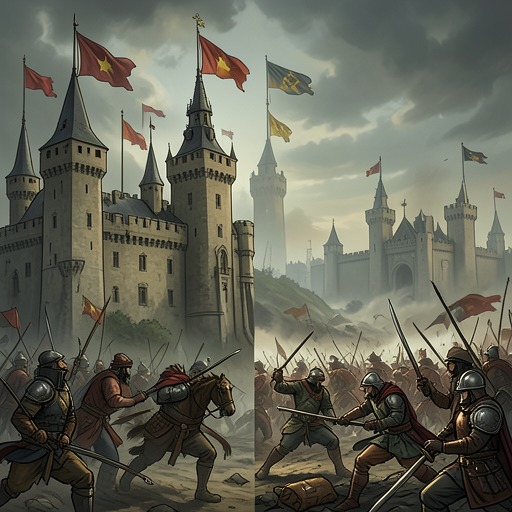
A Clash of KingsRobb Stark is the young ruler whose military success makes the northern rebellion a genuine threat to the Lannister regime. Crowned King in the North while still only fifteen, he inherits not merely a title but the weight of restoring a lost political identity, directing armies across hostile terrain, negotiating through family captivity, and deciding whether victory can be converted into peace. His decisive significance lies in the contrast between the speed of his rise and the pressures that immediately expose its cost.
Crown and Identity
Robb’s crown is newly forged in the image of the ancient crown of the Kings of Winter, which had been surrendered to Aegon the Conqueror three centuries earlier and whose later fate was unknown. Made by Lord Hoster’s smith, it is an open circlet of hammered bronze marked with the runes of the First Men and crowned by nine black iron spikes shaped like longswords. It contains no gold, silver, or gemstones: bronze and iron are presented as the metals of winter, dark, durable, and suited to resistance against cold. The object therefore restores a political memory while rejecting the ornamental wealth associated with southern kingship.
Catelyn Stark watches Robb repeatedly adjust the crown in Riverrun’s Great Hall, pushing it back over his thick auburn hair, moving it forward again, and turning it a quarter turn in search of a more comfortable fit. The gestures make kingship physical rather than abstract. The crown is both emblem and burden, and its awkwardness is intensified by his age: the boy must visibly learn to bear an office that older men have already placed upon him.
Military Rise
Robb’s western campaign produces a victory large enough to alter the balance of the war. Maester Luwin reports that he has shattered a Lannister army at Oxcross, taken several castles, and written from Ashemark, formerly the stronghold of House Marbrand. The victory is not presented as a minor raid but as a campaign that has carried Robb deep into enemy territory and forced news of his success back to Winterfell, where Bran Stark hopes that his brother is coming home even as further battles prevent it.
The account of the attack shows why Robb’s reputation becomes inseparable from the name of the Young Wolf. His northern forces creep into Lord Tywin Lannister’s camp and cut the horse lines before sending Grey Wind among the animals. War-trained destriers panic; knights are trampled in their pavilions; soldiers wake in terror and flee, abandoning weapons to run faster. Ser Stafford Lannister dies while pursuing a horse, Lord Rickard Karstark drives a lance through his chest, and Ser Rubert Brax, Ser Lymond Vikary, Lord Crakehall, and Lord Jast are also killed. More than fifty survivors are captured, including Lord Jast’s sons and Martyn Lannister.
The result generates rumors that the old gods of the north are marching with Robb, but Tyrion Lannister rejects sorcery as an excuse for military incompetence. He attributes the disaster to the camp’s failure to post sentries and to the raw quality of its host, made up of apprentice boys, miners, fieldhands, fisherfolk, and the sweepings of Lannisport. Robb’s achievement therefore operates on two levels: it is magnified by enemy superstition, yet explained within the material logic of surprise, cavalry disruption, weak preparation, and disciplined exploitation of an exposed camp. Even the apparent mystery of how he reached the army remains tied to the fact that Lannister forces still hold the stronghold at the Golden Tooth.
Peace Offer and Political Leverage
Robb does not treat military success as an end in itself. When Ser Cleos Frey is brought before him at Riverrun, Robb stands with his longsword in hand and Grey Wind at his side, then announces an offer of peace to the Queen Regent. He promises to sheath his sword and end the war if his terms are met. The setting gives the proposal the force of a command, while the weapon and direwolf preserve the threat behind the diplomacy.
His conditions place the safety of his sisters at the center of the bargain. Cersei Lannister must release Arya Stark and Sansa Stark and provide sea transport from King’s Landing to White Harbor. Sansa’s betrothal to Joffrey Baratheon must be ended. Only after Robb receives word from his castellan that his sisters have returned unharmed to Winterfell will he release the queen’s cousins, Willem Lannister and Tion Frey, granting them safe escort to Casterly Rock or wherever Cersei wishes them delivered.
The proposal reveals Robb’s power as both sovereign and brother. Prisoners are not merely trophies: they are instruments for recovering his family and testing whether the opposing court will recognize his conditions. At the same time, the terms show the limits placed on him by captivity and distance. His ability to make peace depends upon information reaching him, hostages surviving, and the Lannister court accepting that the northern king can dictate an exchange on nearly equal terms.
War’s Wider Shape
Robb’s rise occurs within a conflict whose geography continually exposes the difference between a king’s authority and the systems required to sustain it. At Storm’s End, Catelyn Stark sees Stannis Baratheon’s besieging army appear insignificant beneath the castle’s massive pale-grey walls, a contrast that recalls the ancient story of Durran Godsgrief and Elenei. The castle’s identity is built around defiance against storms, repeated destruction, and pressure from gods, lords, priests, and smallfolk to surrender. Against that background, Robb’s own posture of resistance acquires a broader political resonance: royal legitimacy is imagined as the capacity to endure forces that demand submission.
Yet the war also shows that boldness can become dangerous when separated from planning. Stannis’s fleet, organized into ten lines of twenty ships, advances toward King’s Landing with four times as many ships as the boy king’s fleet. Its haste is partly explained by earlier losses: two cogs are wrecked in Shipbreaker Bay, a Myrish galley founders in the Straits of Tarth, and a storm scatters the fleet in the Gullet before most ships regroup behind Massey’s Hook in Blackwater Bay. The subsequent raising of the chain across the Blackwater Rush turns numerical superiority into catastrophe, as galleys crash into the boom and burn amid red-hot steel, blazing wood, and green flame. Robb’s campaign is not identical to this battle, but the contrast clarifies the book’s military logic: victory depends not only on courage or numbers but on reconnaissance, terrain, timing, and the ability to foresee the enemy’s prepared defenses.
Reputation, Consequence, and Symbolic Role
Robb’s victories make him “my father’s bane” in Tyrion’s assessment, while Joffrey Baratheon becomes Tyrion’s own problem. The parallel compresses the political structure of the war into a family conflict: Robb threatens Tywin Lannister’s power in the field, while Joffrey’s conduct destabilizes Tyrion’s position within the capital. Robb’s threat is therefore both military and dynastic, because every battlefield success strengthens the claim represented by his crown.
His connection with Grey Wind further shapes the way others understand him. The direwolf is physically present in the attack on the Lannister camp, and enemy survivors transform that fact into tales that the old gods themselves accompany Robb. Later, after the fighting, Summer and Shaggydog prowl through the ashes of the destroyed encampment, moving through burned and collapsed shelters, bodies covered by crows, and the remains of a dying horse. The wolves’ presence gives the aftermath an animal perspective in which human war appears as fire, noise, blood, death, and abandoned structures. Robb’s symbolic identity as the wolf king thus carries an unsettling double meaning: it inspires resistance and unity, but it also binds his kingship to the predatory violence of the war that made him.
Robb Stark’s arc in the supplied material is consequently one of ascent under pressure rather than completed triumph. He possesses enough authority to win major battles, take castles, command hostages, and offer terms to the Queen Regent, yet the crown still shifts uneasily on his head. The narrative presents him as a gifted young commander whose victories create political possibility while multiplying obligations. His decisive struggle is not simply to defeat House Lannister, but to make military power serve family recovery, northern sovereignty, and an end to war before the demands of kingship consume the boy who must carry them.